
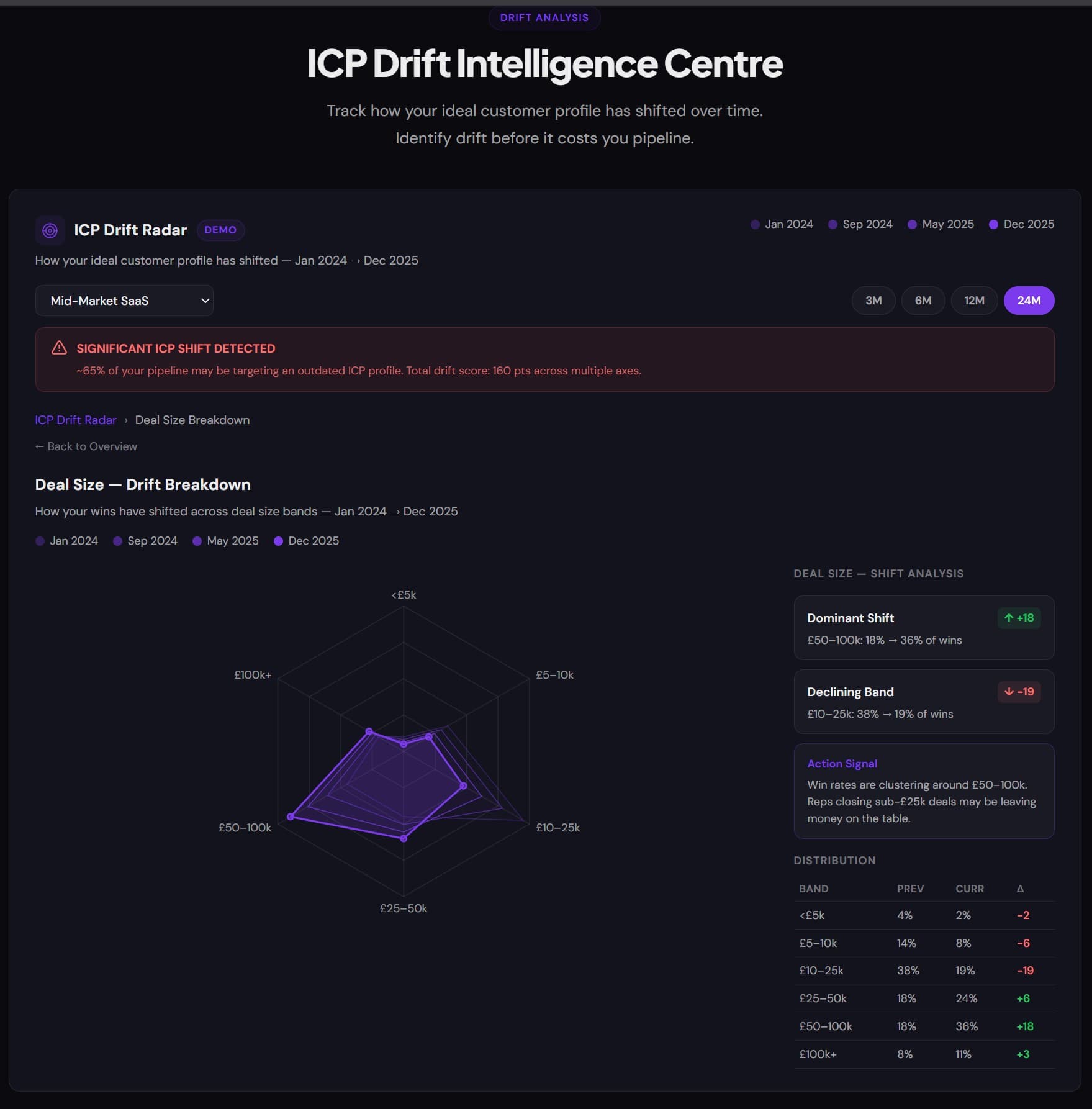
Updated: corrected for accuracy, 12 October 2026. The closing line now says a few minutes rather than three minutes, because report times vary.
Correction, 17 September 2026. An earlier version of this post said Telepath tracks ICP drift automatically, updates the winning profile as each deal closes, and surfaces the trend. That overstated what the product does. What is live: a nightly check that reads your model as fresh or stale against the won deals it was built from, and a refit that runs only when you ask for it. Telepath does not yet show which way the profile has moved. The closing section below now says exactly that.
Your ICP was probably right when you wrote it.
The problem is that you wrote it six months ago. Or twelve months ago. Or, if you're being honest, during a strategy offsite two years ago that nobody has revisited since.
Markets move. Your product evolves. Competitors enter and exit. Buyer behaviour shifts. Economic conditions change. The customer profile that accurately described your best buyers eighteen months ago may not describe the deals you're winning today. And if your targeting, messaging, and qualification criteria are still calibrated to the old profile, you're aiming at where the target used to be.
This is ICP drift. And almost nobody is tracking it.
What ICP drift actually looks like
ICP drift isn't a dramatic overnight shift. It's gradual, which is exactly why it's dangerous. It happens in small increments that are invisible in any single quarter but compound into a significant misalignment over time.
Here are the patterns that indicate your ICP has drifted:
Your win rate is declining but nobody can explain why. The team is working just as hard. Activity metrics look healthy. But deals that used to close are stalling, and the ones that do close are taking longer. The common diagnosis is "the market is tougher" or "competition is increasing." Sometimes that's true. But often, the real issue is that the pipeline is full of prospects that match the old ICP while the actual winning profile has shifted. Catching that needs ideal customer profile software that re-derives the profile from recent wins, not a document nobody has reopened.
Your fastest-growing segment isn't the one you're targeting. You keep closing deals in a vertical or company size band that wasn't part of the original ICP. Sales might even be treating these wins as anomalies rather than signals. "Oh, that's just an outlier." Except it's happened four times this quarter.
Marketing and sales are arguing more than usual. Marketing is delivering leads that match the agreed ICP. Sales is saying the leads are rubbish. Both are right, because the ICP they agreed on no longer reflects what actually closes. The fight isn't about lead quality. It's about an outdated definition of quality.
New reps take longer to ramp. They're being trained on a profile that worked historically but doesn't match current reality. They target the right companies according to the playbook, get mediocre results, and eventually learn through expensive trial and error what actually works today. That ramp time is a direct cost of ICP drift.
Your product-market fit feels wobbly. Not because the product has changed, but because the market you're pointing it at has. The product still solves a real problem. Just for a slightly different buyer than the one you're targeting.
Why traditional ICP reviews don't catch it
Most teams that do revisit their ICP do it annually, in a meeting, based on opinions. The VP Sales shares their perspective. Marketing shares theirs. Someone pulls up a few recent wins as anecdotal evidence. The group reaches a consensus that feels reasonable. They update a slide deck. Nothing fundamentally changes.
The problem with this approach is threefold.
First, it's too infrequent. Markets don't drift on an annual cycle. A quarterly or even monthly cadence is closer to the reality of how quickly B2B buying patterns shift.
Second, it's qualitative. Opinions about who your best customer is are influenced by recency bias, deal size bias, and availability bias. The VP Sales remembers the £200K deal that closed last month but not the eight £30K deals that closed with less drama. The pattern that emerges from group discussion is the pattern that's most memorable, not the one that's most representative.
Third, it doesn't measure magnitude. Even when a team correctly identifies that "we're winning more in fintech lately," they can't quantify how much the weighting has shifted. Is fintech now 50% of wins, up from 30%? Or is it 35%, up from 30%? The strategic response is completely different depending on the magnitude, and qualitative reviews can't distinguish between the two.
How to actually detect ICP drift
Detecting drift requires comparing your current winning pattern against your historical one. That means you need two things: a quantified view of what your ICP looked like six or twelve months ago, and a quantified view of what it looks like now.
Step 1: Baseline your current ICP quantitatively. Analyse your closed-won deals from the last 12 months. Identify the key characteristics, weight them by how strongly they concentrate in your wins, and document the winning profile with numbers, not adjectives.
Step 2: Compare against the previous period. Run the same analysis on deals from 12 to 24 months ago (you can run a free ICP report on your HubSpot won deals for the current period first). Where are the weights different? Has a particular industry grown from 15% of wins to 30%? Has the average winning deal size shifted? Has a new geography emerged?
Step 3: Identify the outliers. Look at recent wins that don't fit the historical ICP. These aren't anomalies. They're signals. If you're consistently closing deals in a segment that wasn't part of the original profile, that's the market telling you something. Listen.
Step 4: Quantify the gap. Don't just note that "things have shifted." Measure by how much. A 5% shift in industry weighting is noise. A 15% shift is a strategic signal. A 30% shift means your ICP is fundamentally wrong and needs immediate correction.
Step 5: Check continuously, decide deliberately. The best approach isn't a quarterly review: it's a system that checks, on a fixed cadence, whether the deals your profile was built from have changed, and tells you when they have, so the decision to rebuild is yours and is made on evidence.
The ICP that tells you when it is out of date
This is the core idea behind pipeline intelligence: your ICP should be a living system, not a static document.
Here is what Telepath Pro does today, and no more. Your ICP is built from your closed-won deals and pinned. Every night, after your deals sync, it checks whether the won deals that model was built from have changed: a new win, a lost one, a field on a won deal that carries weight. If nothing has changed, the model reads fresh. If something has, it reads stale, and you are told how many new wins it has not seen. The model does not update itself. It refits only when you say so, and until you do, your open deals keep being scored against the model you approved.
What it does not yet do is show you which way the profile has moved. Fresh or stale is a yes-or-no reading, not a trend. Transition history, the view that would put this month's profile against last quarter's, is not built.
No annual offsite required. A nightly check against your own data, a plain reading, and a decision that stays yours.
Your ICP isn't wrong. It may just be out of date. Find out whether it is.
A few minutes, free: telepath.pro
Related reading: