
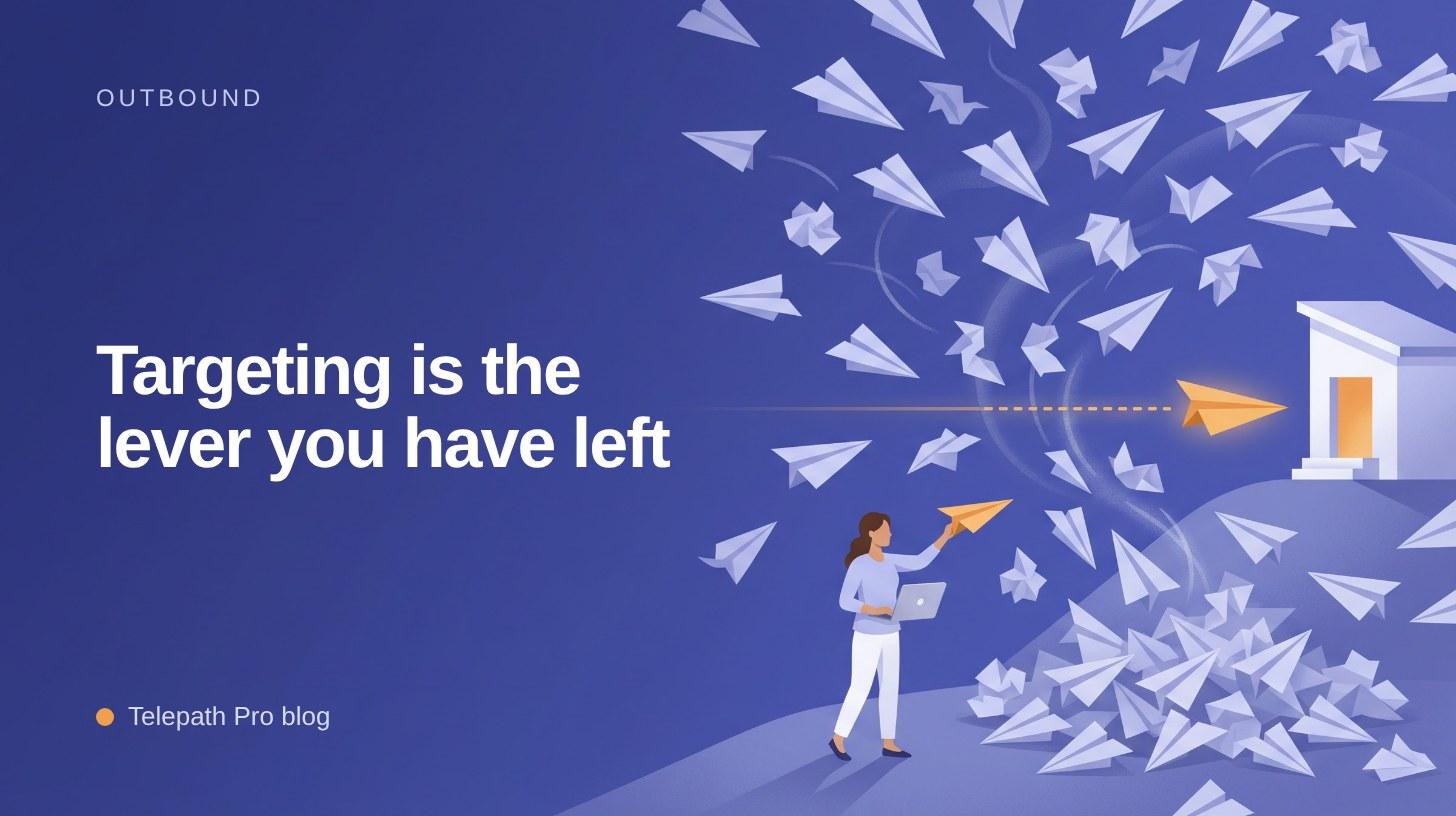
AI made competent copy free and sending cheap. What is left to separate your outbound from everyone else's is who you send it to.
I've spent 20 years in B2B sales, and I still send cold emails most weeks. The channel feels harder every year, and the data now says where the difference comes from.
What the numbers say
Instantly's 2026 benchmark, built from its platform data for January to December 2025, puts the average cold email reply rate at 3.43%. Its top performers exceed 10%: same channel, same tools, two to four times the replies by Instantly's count.
Instantly's own reading of that gap is worth quoting: reply rates held up despite growing volume, "proving that relevance, not quantity, drives conversations."
Why volume stopped being free
Sending got cheap. AI writes a passable email in seconds and sequencing tools can send thousands of them a month from one seat. So buyers' inboxes fill up.
Buyers ignore more of it, and some of them report it. Google's sender guidelines tell bulk senders to keep their user-reported spam rate below 0.1% and never let it reach 0.3%. At 0.1%, that is one "report spam" for every thousand emails sent. Past 0.3%, Google says delivery support and mitigations are no longer available.
The levers, one by one
Copy used to separate good outbound from bad. AI has made competent copy free, so everyone has it and it no longer stands out.
Volume now carries a cost. Each extra send spends a little of your sender reputation, and the complaint limits mean you can run out.
That leaves who you send to. An email about a problem the reader has, from a company that has solved it for businesses like theirs, still gets answered. The same email sent to a company that was never going to buy earns silence at best and a spam report at worst.
Where most target lists come from
Ask how the outbound list was built and the answer is usually an ICP slide: an industry or two, a headcount range, a region. Somebody wrote it from memory, often a couple of years ago.
Your CRM holds better evidence. Each closed-won deal is a record of a company that did buy. Put fifty of them side by side and you will usually find patterns the slide never mentioned, along with segments on the slide that have produced almost no wins.
What to do this week
- Export your last 50 closed-won deals with industry, headcount, region and lead source.
- Count how many wins fall in each group.
- Do the same count for your current outbound list.
- Cut the groups that fill the list and barely appear in the wins, and spend the time you get back on writing better emails to the rest.
You can do this in a spreadsheet in an afternoon.
Where Telepath fits
A spreadsheet works for a one-off check on three or four fields, and it is out of date the day you finish it. I built Telepath Pro to do the same job continuously. It reads the deals you have won in HubSpot, works out what those customers have in common, and scores your open opportunities and companies by how closely they resemble them. The numbers are computed in code, not guessed by an AI.
If you want to see your own patterns first, the free ICP report reads your won deals from HubSpot or a CSV export.
Sources
- Instantly, Cold Email Benchmark Report 2026: https://instantly.ai/cold-email-benchmark-report-2026
- Google, Email sender guidelines FAQ: https://support.google.com/a/answer/14229414